

What Building a $1M Service Business Taught Me About Operations
March 17, 2026
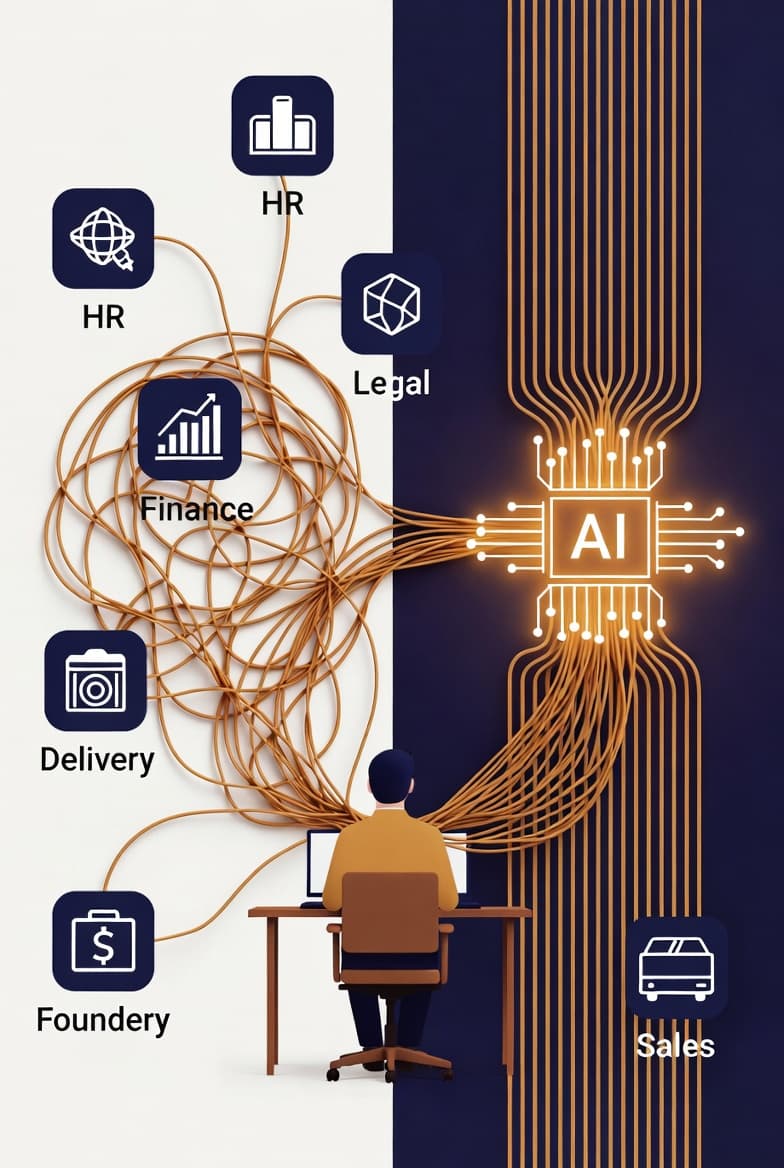
Operations tangled vs AI-rewired — from chaos to structured workflows
In 2018, I left a 20-year corporate career running operations for global banks — Deutsche Bank, Credit Suisse, Bank of England — and started a blockchain consulting practice called Rewired.one.
By 2022, it hit $1M+ ARR. Three enterprise clients, contracts over $250K each, 85% client retention, a distributed team across the US, UK, and Australia.
On paper, it looked like everything I'd wanted. In practice, I'd rebuilt the exact thing I'd left.
Indie Hackers featured the full story — the $1M ARR trap, the golden handcuffs, the decision to start over. But what I didn't fully articulate then was the operations lesson buried inside it. That's what I want to unpack here, because it's the same lesson I now see in every founder I work with.
The operations problem hiding inside a revenue problem
When the business was growing, I told myself the problem was sales. Or hiring. Or bandwidth. The usual founder complaints.
It wasn't. The problem was operations.
I was the operating system. Every client decision flowed through me. Every delivery milestone needed my sign-off. Every new hire needed my onboarding. I owned HR, legal, finance, compliance, vendor relationships, and delivery — simultaneously. I'd built a company that ran on my presence, not on systems.
Sound familiar? It should. This is what every service business looks like at $500K–$2M. Revenue scales. Operations don't. The founder becomes the bottleneck and doesn't realize it because the revenue number keeps climbing.
What corporate taught me (that I forgot to apply)
The irony is that I knew better. I'd spent 20 years solving exactly this problem — at scale. At Credit Suisse, I recovered a failing £6B daily settlements program using Lean diagnostics. At Deutsche Bank, I ran the ABN AMRO integration across 12 project managers. At the Bank of England, I built a risk assessment system that translated complex regulatory requirements into working software.
In every case, the pattern was the same: map the operations, find the bottlenecks, install rhythm, remove the human dependency from the critical path.
But when it was my own business, I skipped all of that. I went straight to selling and delivering, and let the operations grow organically. Organically, it turns out, means chaotically.
The seven things that were broken
Looking back, here's what was actually wrong with my $1M business — and none of it was about code or product:
Client onboarding was manual. Every new engagement required me to personally set up project tracking, comms channels, access credentials, and kick-off documentation. This took 2–3 days per client. It should have taken 2 hours with a templated workflow.
Delivery tracking was in my head. I knew where every project stood because I was in every conversation. There was no dashboard, no async status system, no way for anyone else to know what was happening without asking me.
Financial reporting was reactive. I'd reconcile revenue and expenses at the end of each month. By then, the information was stale. Cash flow surprises happened because I was always looking backward.
Hiring was ad hoc. When we needed someone, I'd start searching. There was no pipeline, no evaluation framework, no onboarding system. Every hire was a one-off project.
Legal and compliance lived in email threads. Contracts, NDAs, amendments — scattered across inboxes. Finding the current version of anything was archaeology.
Knowledge wasn't captured. When a team member left, everything they knew left with them. I lost three weeks once when an employee departed with all my passwords. That experience eventually led to Icebox, but the deeper problem was that nothing in the business was documented in a way that survived one person leaving.
I was the integration layer. Every function — sales, delivery, finance, legal, HR — connected through me. I was the human API between all the parts of my own business. And like any single point of failure, when I was overloaded, everything slowed down.
Tech ops and agile: the delivery rhythm most founders skip
There's a piece of this I haven't mentioned yet — the actual mechanism for how work moves through a company. Most founders don't think about this until they're drowning.
In the corporate world, I spent years implementing agile delivery frameworks. At Handelsbanken, I designed the target operating model for their Brexit regulatory program — it became the blueprint for how the bank managed every regulatory change program after that. At Cognizant, I launched a global agile community across geographies. At Credit Suisse, I used Lean diagnostics to recover a program that was failing precisely because nobody had installed a delivery rhythm.
Agile gets a bad reputation because most people experience it as ceremony — standups nobody wants, sprint planning that takes half a day, retrospectives where nothing changes. That's not agile. That's theater.
Real agile is an operating system for how work flows through your company. It answers three questions every week: what are we doing, what's blocking us, and what did we learn? When those three questions get answered with discipline and honesty, work moves. When they don't, founders end up as the human routing layer — fielding Slack messages, unblocking decisions, and wondering why nothing ships on time.
For founders, I think of agile not as a software methodology but as an operational delivery mechanism. It works for engineering. It also works for sales ops, client delivery, hiring pipelines, and product launches. The cadence is the same: set priorities, execute in short cycles, review outcomes, adjust. Repeat.
The problem is that most startups either ignore delivery rhythm entirely (chaos) or cargo-cult the enterprise version (death by process). What I install for founders sits in between — lightweight enough that a 3-person team doesn't feel burdened, structured enough that a 15-person team doesn't lose track of who's doing what.
On the tech ops side specifically, this is where most founders have the biggest blind spot. Your CI/CD pipeline, your monitoring, your incident response, your deployment cadence — these are operations decisions, not engineering decisions. Who can deploy to production? What happens when something breaks at 2am? How do you know if last week's release actually moved a business metric?
At Rewired, I've taken this further with AI/CD — agentic pipelines where AI handles the routine implementation and testing while humans retain approval and strategy. But even without AI in the loop, the basics matter: if your tech ops are ad hoc, your product delivery will be ad hoc. And ad hoc delivery is how you end up with a $1M revenue business that feels like it's held together with string.
The agile frameworks I used at Deutsche Bank for 60-person teams are overkill for a startup. But the principle underneath them isn't: make work visible, set a rhythm, clear blockers fast, and measure what you ship against what you planned. That's operations. It just happens to also be the best way to build software.
What I'd do differently (and what I do now)
If I started that business today, I'd spend the first month on operations before signing a single client.
I'd map every function — sales, delivery, onboarding, finance, legal, HR — and ask one question for each: can this run without me in the room? If the answer is no, that's where AI and automation go first.
Not AI for the sake of AI. AI wired into specific workflows with clear triggers and outcomes. Client sends a signed contract? Onboarding workflow triggers automatically — project board created, Slack channel opened, kick-off doc generated from template, welcome email sent. Nobody needs to remember to do any of it.
Weekly delivery status? Auto-generated from project data, not from me writing Loom updates at 11pm. Financial reporting? Real-time dashboard, not a monthly spreadsheet exercise.
This is the approach I now take with every founder I work with at Rewired. I audit their operations function by function, find where they're the bottleneck, and wire AI into the workflows that shouldn't depend on a human. Not all at once — one function at a time, in priority order, starting with whatever's closest to breaking.
The real lesson
The $1M ARR trap wasn't about money. It was about building a business that couldn't run without me.
Revenue is not the same as operational health. You can have $1M in revenue and an operation that's one founder vacation away from chaos. I know because I did.
The fix isn't hiring more people. It's building systems — operating rhythm, automated workflows, documented processes, AI where it creates leverage — that make the founder less necessary to daily operations.
That's what 25 years of running operations at global banks taught me. It just took building my own broken company to remember it.
I'm Torben Anderson — fractional CTO and AI operations architect at Rewired. I help founders with traction rewire how their companies operate. If your business runs because you're in every decision, let's talk.
The original version of this story was featured on Indie Hackers.
Ready to rewire your operations?
If you're a founder whose company runs because you're in every decision, this is what working differently looks like.
Start with Get Clear — a 90-minute diagnostic where we map your current operations, identify hidden risks, and build a prioritized 90-day roadmap. $797, and 100% counts toward any retainer.
Or explore fractional CTO pricing to see what hands-on leadership and execution looks like. You can also hire a fractional CTO to learn more about how the engagement works.